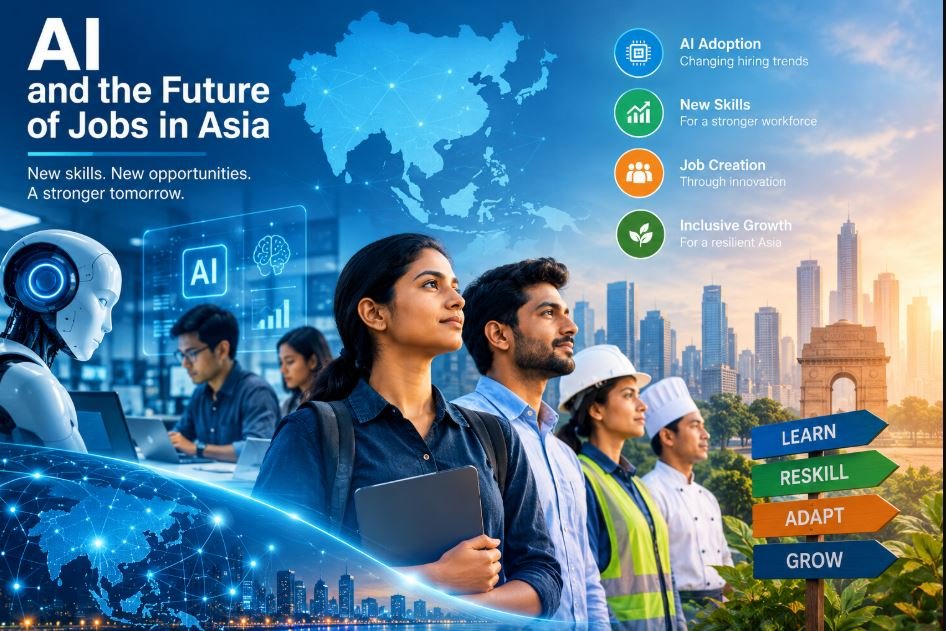
AI Is Reshaping Jobs in Asia: What India Must Do to Stay Ahead
Artificial intelligence is changing hiring patterns across Asia, creating demand for new technology skills while putting pressure on some traditional roles. For India, the challenge is to turn AI adoption into sustainable job creation.
Artificial intelligence is beginning to change not only how companies operate but also whom they hire, which skills they value and how work gets done. Across Asia, businesses are adopting AI-powered tools to improve productivity, automate routine activities and develop new services. However, this technological shift is creating a complex challenge for governments, employers and workers.For India, the stakes are particularly high. With a large working-age population entering the employment market, the country needs to ensure that technological progress translates into meaningful job opportunities rather than leaving sections of the workforce behind.
AI Is Changing Hiring Trends Across Asia
An analysis highlighted in the International Monetary Fund’s October 2026 Regional Economic Outlook examined approximately 40 million online job advertisements across 19 Asian economies.The findings indicate that demand for jobs more exposed to artificial intelligence declined by nearly 10% relative to occupations less exposed to the technology, following the launch of ChatGPT in November 2022.This does not necessarily mean that AI is eliminating employment across the board. Instead, the data points towards a changing labour market in which some traditional responsibilities are becoming less important, while new technical and business skills are gaining value.
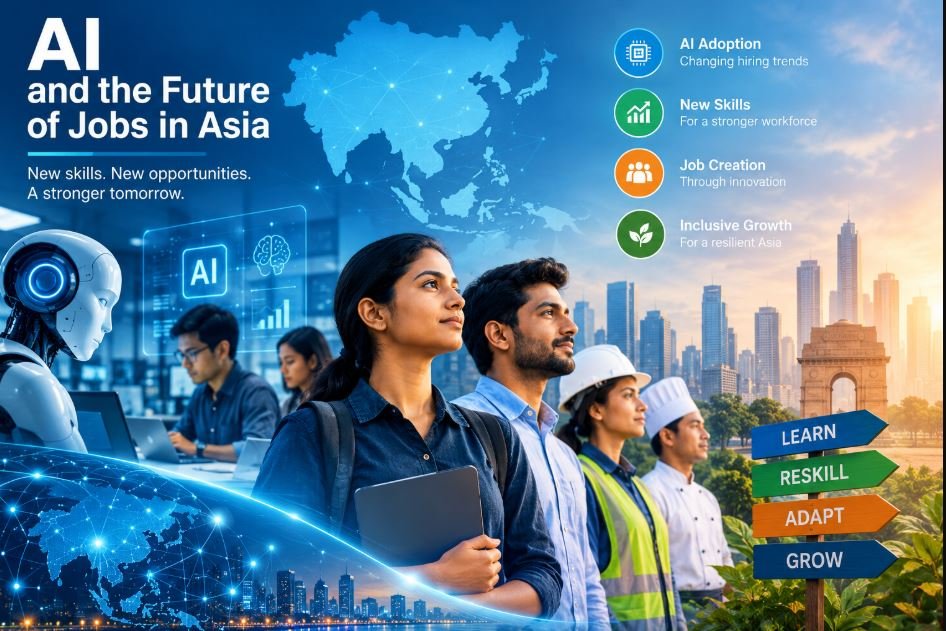
Roles involving repetitive, predictable tasks may face greater pressure as automation expands. At the same time, businesses need professionals who can implement AI solutions, integrate them into existing operations and use them to solve practical problems.
Companies Adopting AI May Create New Employment Opportunities
The relationship between artificial intelligence and employment is more complicated than a simple story of machines replacing people.
According to the IMF analysis, companies that have adopted AI are experiencing stronger growth in labour demand than businesses that have not adopted the technology. This suggests that AI can complement human capabilities and support business expansion, even as it changes the nature of individual jobs.Companies increasingly need people who understand both technology and business operations. Skills such as AI implementation, prompt engineering, retrieval-augmented generation (RAG) and AI agent development are emerging as areas of opportunity.
The long-term employment impact will depend partly on whether companies use AI primarily to reduce costs or to develop new products, improve customer experiences and expand their businesses.
Why India Cannot Afford to Ignore the AI Skills Gap
India may initially experience less disruption in some areas because a significant share of its workforce remains employed in sectors with lower direct exposure to AI.
However, this should not be mistaken for a permanent advantage.
One of India’s major economic priorities is to move workers into more productive employment across manufacturing, technology-enabled services and other expanding industries. If AI changes the skills required in these sectors faster than workers can adapt, the transition could become more difficult.India faces a two-part challenge: preparing existing employees for changing job requirements while creating sufficient employment opportunities for young people entering the workforce.The country will need stronger industry–education partnerships, practical AI training and greater access to digital infrastructure to help workers participate in the emerging economy.
The New Skills Employers Will Look For
As AI becomes part of everyday business operations, employers are likely to place greater emphasis on a combination of technical knowledge, problem-solving ability and human judgement.
Some important skill areas include:
- AI literacy: Understanding how AI tools work, where they are useful and where their limitations lie.
- AI implementation: Applying AI solutions to real business processes rather than simply experimenting with new tools.
- Data and analytical skills: Interpreting information and using evidence to make better decisions.
- Human–AI collaboration: Combining automated capabilities with human judgement, creativity and accountability.
- Continuous learning: Updating professional skills as technology and workplace expectations evolve.
Workers do not necessarily need to become AI engineers to benefit from this transition. Professionals in finance, operations, sales, customer service, telecommunications and management can also gain an advantage by learning how to use AI effectively within their own fields.
What Businesses and Policymakers Need to Do
The transition to an AI-driven economy cannot be managed by employees alone. Companies, educational institutions and governments all have a role to play.Businesses should invest in employee training alongside technology deployment. Reskilling existing employees can help organisations retain institutional knowledge while preparing teams for new responsibilities.Educational institutions need to update curricula to include digital capabilities, analytical thinking and practical exposure to emerging technologies. Training programmes should also be accessible to workers who cannot afford to leave their jobs to acquire new skills.Policymakers must focus on employment creation, workforce mobility and access to training. The objective should be to ensure that productivity improvements support broader economic participation rather than concentrating the benefits of AI among a limited group of companies or highly skilled workers.
The Road Ahead: Turning AI Disruption into an Opportunity
Artificial intelligence is changing the employment landscape, but the outcome is not predetermined. The same technology that automates certain tasks can also help businesses innovate, improve productivity and create demand for new capabilities.For India, the central question is not simply how quickly organisations adopt AI. It is whether workers, businesses and educational institutions can adapt quickly enough to capture its economic benefits.A successful transition will require a balanced approach that combines technological investment with workforce development and inclusive job creation.
The future of work in India will depend not only on what AI can do, but also on how effectively people learn to work alongside it.