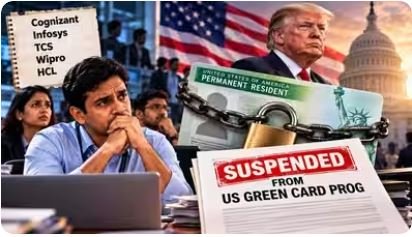
US authorities have tightened scrutiny of employment-based green card applications, putting Indian IT giants Infosys, TCS and Wipro under the spotlight amid allegations of immigration programme abuse.
Meta description: The Trump administration has suspended eight technology companies, including Infosys, TCS and Wipro, from the US employment-based green card process amid allegations of immigration programme abuse.
US Expands Scrutiny of Indian IT Companies
The US administration under President Donald Trump has intensified its scrutiny of employment-based immigration programmes, suspending several major technology companies from a process used to sponsor foreign employees for permanent residency.
The companies affected include Indian IT services leaders Tata Consultancy Services (TCS), Infosys, Wipro and HCL echnologies, alongside Microsoft, Adobe, Cognizant and Capgemini.Announced on October 8, 2026, the measure prevents the affected companies from submitting new applications under the Permanent Labour Certification (PERM) programme and halts the processing of pending applications covered by the suspension.
US officials have alleged that certain employers have misused immigration programmes in ways that disadvantage American workers. These are allegations made by the administration and should not be treated as established findings of wrongdoing against every company named.
What Is the PERM Programme?
PERM is an important step in many employer-sponsored employment-based green card applications in the United States.Under this process, an employer generally needs to demonstrate that there are no able, willing, qualified and available US workers for the relevant position, and that hiring a foreign worker will not adversely affect the wages and working conditions of similarly employed American workers.By suspending the affected companies from this process, the administration has created a new obstacle for employees who depend on their employers to sponsor their permanent residency applications.
However, the immediate restriction concerns the PERM process. It does not automatically cancel existing green cards or revoke current H-1B work authorisation.
Why Has the Trump Administration Taken This Step?
US officials argue that some employers may be using foreign-worker programmes in ways that put American employees at a disadvantage.
Vice President JD Vance and Labour Department officials have criticised hiring practices that they believe can allow companies to recruit foreign workers while reducing opportunities for US workers.Microsoft received particular attention during the announcement. The administration cited its workforce reductions alongside its use of H-1B visas and employment-based green card applications as part of its argument for stronger enforcement.
The wider action also includes major IT outsourcing and consulting companies, including Infosys, TCS and Wipro.The development reflects a broader policy debate in the United States: how to balance access to global technology talent with the government’s stated objective of protecting domestic employment and wages.
How Could Indian IT Professionals Be Affected?
The consequences could be significant for Indian professionals working in the United States, particularly those whose long-term immigration plans depend on employer-sponsored green cards.
1. Potential delays in permanent residency
Employees whose green card applications still require PERM certification could face delays or uncertainty while the suspension remains in effect.
2. Greater uncertainty for workers approaching the H-1B limit
H-1B status is generally subject to a six-year maximum, although qualifying workers may be eligible for extensions under certain circumstances linked to their employment-based green card process. Employees approaching that limit should seek individual immigration advice.
3. More complicated career decisions
Some affected employees may need to review their long-term plans, including alternative employers or other lawful immigration options. Whether a change of employer is possible, and how it affects an application, will depend on the individual’s circumstances.
4. A more difficult route for future applicants
The suspension may also affect professionals who expected their employer to begin green card sponsorship in the future. The extent of the impact will depend on how long the restrictions remain in force and whether they are challenged or modified.
What Does This Mean for India’s IT Industry?
The decision introduces another source of uncertainty for Indian technology companies that rely on cross-border staffing and client delivery in the US market.If immigration restrictions persist or expand, companies could reassess how they deploy employees, manage US-based projects and allocate work between overseas client locations and delivery centres in India.Possible responses include increasing local hiring in the United States, expanding delivery from India, strengthening compliance procedures and diversifying growth across other markets.However, these are potential business responses rather than confirmed plans by every company affected.
What Happens Next?
The immediate outlook depends on the duration and scope of the suspension, any legal challenges and further decisions by US immigration and labour authorities.
For affected employees, the most important step is to understand the current stage of their immigration case rather than assume that all work authorisation has been withdrawn.For India’s IT sector, the development highlights the growing importance of immigration policy, regulatory compliance and workforce planning in international technology services.The key takeaway: The US action creates a new hurdle for employer-sponsored green cards at several major technology companies. While it does not automatically cancel existing H-1B visas, it could complicate permanent residency plans for affected professionals and increase uncertainty for Indian IT companies operating in the United States.
Editorial note: This article is an independently written summary of publicly reported developments. Allegations are attributed to US officials; the suspension itself should not be interpreted as proof that every affected company violated immigration law.