
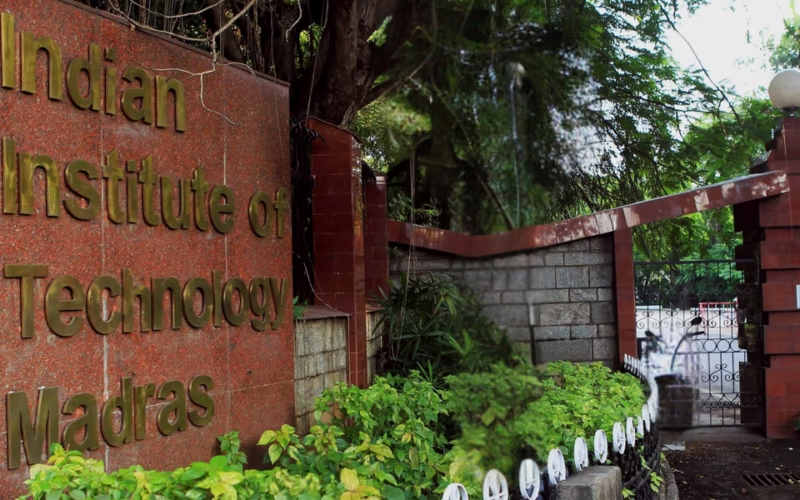
India’s premier technology institute is expanding its entrepreneurship ecosystem with a long-term goal of supporting 1,000 startups and creating a stronger pipeline of companies reaching public markets.
The Indian Institute of Technology Madras (IIT Madras) is setting an ambitious target for its startup ecosystem, aiming to support 1,000 startups by 2032 and build a pipeline capable of producing around one IPO every month.
The initiative reflects the growing role of India’s leading educational institutions in nurturing technology companies, deep-tech ventures and innovation-driven businesses.
From Campus Innovation to Public Markets
IIT Madras has increasingly positioned entrepreneurship as an important part of its institutional strategy. Through incubation programes, research initiatives, industry partnerships and access to academic expertise, the institute has sought to help researchers, students and entrepreneurs turn ideas into commercial businesses. The new target goes beyond simply increasing the number of startups. A key ambition is to create companies capable of scaling into significant businesses and eventually accessing public capital markets.An IPO every month would represent a substantial increase in the number of IIT Madras-linked companies reaching the public markets and would underline the institute’s ambition to build a long-term startup-to-IPO ecosystem.
Deep Tech at the Centre
A major focus is expected to remain on deep technology, where research and intellectual property can provide the foundation for new businesses.
Areas such as artificial intelligence, semiconductor technology, robotics, healthcare technology, climate technology, advanced materials and other emerging technologies could provide opportunities for research-led startups emerging from the institute’s ecosystem.
Unlike conventional startups that can often scale primarily through software and digital distribution, deep-tech companies typically require significant investment in research, product development and commercialization.
Why the Target Matters
India’s startup ecosystem has expanded significantly over the past decade, but converting research into globally competitive technology businesses remains a challenge.Institutions such as IIT Madras can play a role by connecting research, talent, capital and industry within a single ecosystem.A larger pipeline of startups could also create additional opportunities for venture capital investors, strategic companies and eventually public-market investors.
The Road to 2032
The 2032 target effectively places IIT Madras among institutions seeking to build an end-to-end innovation pipeline:
Research → Incubation → Startup → Scale-up → Investment → IPO
The challenge will be ensuring that the focus remains not only on the number of startups created, but also on their survival, commercial traction, intellectual property, employment generation and ability to scale.If the institution succeeds in developing a sustained pipeline of technology companies, its impact could extend well beyond the campus and contribute to India’s broader ambitions around innovation, entrepreneurship and technology-led economic growth.
BizRadar Takeaway
The IIT Madras strategy highlights a broader shift in India’s innovation landscape: universities are increasingly becoming startup engines rather than simply centres of education and research.The more significant test will be whether these institutions can consistently convert academic research into commercially successful companies—and ultimately into businesses capable of accessing India’s public markets.